
Conservative Party Conference: Planning Policies
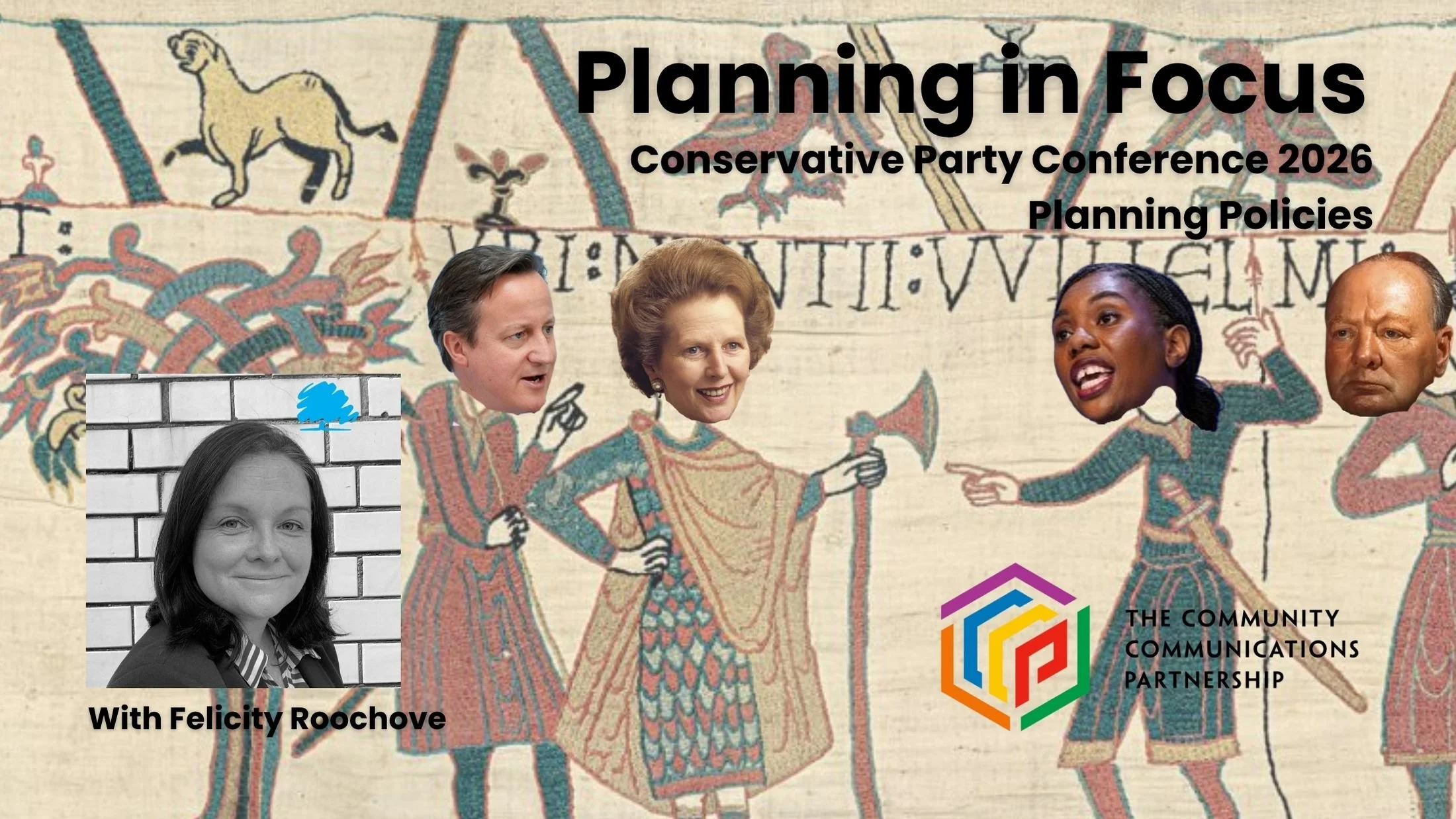
David Lloyd George’s “Homes fit for heroes”, Thatcher’s “Property owning democracy”, Blair’s “Pressures on housing being a barrier to opportunity”, Cameron’s need for a “national crusade to get homes built”, Starmer’s grey belt land plan as new homes “must be built somewhere” and now Burnham’s “with a good home everything is possible” mantra – house building has always been on the political agenda, and it seems that the 2026 Conservative Party Conference has firmly set up the battle lines for the next election cycle.
Whilst Labour’s strategy relies heavily on central planning, strict regional quotas, and bypassing local democratic committees to force construction through a rules based system, Kemi Badenoch’s Conservatives are betting that the electorate will back an unprecedented wave of deregulation. By stripping out net zero requirements, removing local community funding burdens, and abolishing prominent environmental regulators, the Conservatives are positioning themselves as the party of raw market forces. They have used their Conference in Birmingham as a platform for the new era of "common sense" economics, a core part of which is to "totally re-imagine" the UK planning system through the most aggressive deregulation project in a generation.
Shadow Chancellor Andrew Griffith and Shadow Housing Secretary Katie Lam addressed Conference to unveil a package of planning policies designed to speed up delivery of much needed homes.
The big takeaway is a promise to cut up to £50,000 off the cost of building a new home. To achieve this the Conservatives would abolish Natural England and the Environment Agency stating that these organisations can delay growth through rigid regulations, Section 106 and CIL would be streamlined into a single developers levy and the Future Homes Standard requiring energy efficient rules for new builds would be done away with.
Katie Lam argued that these reforms are necessary to reverse Labour’s "completely unjustifiable" rewriting of housing targets. The current targets, she noted, unfairly burden rural constituencies while underperforming in urban areas. And the battle between rural and urban across England’s green and pleasant land, does seem to be one which will dominate this argument going forward. Labour’s centralised mandates and the Conservatives’ deregulation hit these communities in totally different ways. Rural and shire authorities bear the heaviest burden of Labour's mandatory 2026 NPPF formulas. Rural local authorities in England have seen their housing targets increase astronomically, and the Conservatives’ position is built to defend rural seats from this influx. By aiming to scrap mandatory quotas and hand discretion back to councils, they are positioning themselves as protectors of the countryside. Although interestingly, the proposal to abolish Natural England and the Environment Agency could mean that while rural areas might see fewer top down housing targets, the local developments that do go ahead could face fewer green, flooding, and biodiversity safeguards.
The ideological divide gives us clear blue water between these two parties. And for those who think the Conservative Party is increasingly unimportant in national politics – don’t forget the army of councillors across the country who are still fundamental to the planning process. Whether you think the Conservatives are able to form the next government or not, the policy positioning is a crucial part of understanding where Conservative councillors may well place themselves within this argument. Conservatives are generally free thinkers – particularly with planning – but politicians are tribal by nature and therefore actions will often sit firmly within a framework prescribed by the central Party and the Leader.
Whether the public will embrace the ditching of safeguards in exchange for cheaper, faster housing remains the big question, but it does position bricks, mortar and red tape as a key battleground ahead of the next general election.
And from an elections point of view – why not? Underneath many a general election slogan about healthcare, education or national stability – there has often been a rallying cry on housing. The dramatic general election just after World War II had Labour promising a massive council house building programme. In 1951, the Conservatives returned to power with a mandate created by grass roots members to promise the building of 300,000 homes a year – a pledge Housing Secretary Harold McMillan achieved. And in 1979 the “Right to Buy” was a core manifesto pledge, introduced in 1980 by the 1983 general election hundreds of thousands of people had bought their council house.
So, whilst it comes as no surprise that this debate remains firmly within the election strategy playbook, it means that the successful in this industry will be the ones who can catch whichever political football is thrown next, and react accordingly.
Watch this space.
Or instead of watching this space, do something about it – phone the CCP and get strategic political and planning insight for your project.